


B1 Fire Safety Classification: Safety & Certificates for Advertising Displays
Safety at trade shows, events and in public buildings is not optional — it is mandatory. Advertisers and exhibitors repeatedly come across the term "B1 certificate".
At Berlin Display, we know that even the best exhibition stand is worthless if the organizer blocks it because the required fire safety documentation is missing. That is why we rely on certified safety according to DIN 4102-1 and EN 13501-1 for our print media and display systems.
What does B1 quality actually mean?
The German standard DIN 4102-1 classifies building materials and products according to their fire behavior. For advertising technology and display products, class B1 (flame-retardant) is the decisive standard.
Classification overview:
- A1 / A2: Non-combustible, for example metal or concrete.
- B1: Flame-retardant. The material must not continue burning independently after the ignition source is removed.
- B2: Normally flammable. The material continues to burn at normal speed and is often not approved for trade shows.
- B3: Easily flammable and generally prohibited in the construction sector.
Standards compared: DIN 4102, EN 13501 and EN 13773
In addition to the well-known German DIN standard, you will often encounter European classifications. The following comparison helps you read certificates correctly:
1. DIN 4102 vs. EN 13501-1 Euroclass
The European standard EN 13501-1 is increasingly replacing the national DIN classification.
- DIN B1 usually corresponds to Euroclass B-s1, d0 or C-s1, d0.
- s1: low smoke development.
- d0: no burning droplets.
2. EN 13773 – specifically for curtains and textiles
The EN 13773 standard is particularly relevant for vertically hanging textiles such as banners, curtains or molton fabric. Based on this standard, textiles are classified according to their ignition behavior. Materials such as wool, natural silk or special modacrylic fibers often offer better fire resistance and are therefore considered safer.
Our B1 products: print media and display systems
At Berlin Display, we make sure that your advertising products meet the strict requirements for public venues, exhibitions and events.
These products are available with B1 flame-retardant properties:
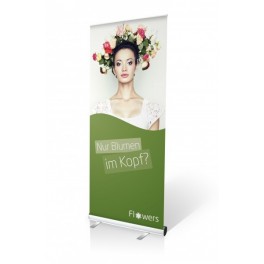
- Roll-ups & displays: high-quality films and fabrics that are self-extinguishing in the event of fire.
- Textile tension frames: printed polyester fabrics, ideal for wall coverings in offices, shops and showrooms.
- Exhibition walls: all our fabric walls meet the B1 standard.
- Banners & tarpaulins: also suitable for outdoor applications when strict fire safety requirements apply, for example on stages or at events.
FAQ – Frequently asked questions about fire safety
1. What does fire class B1 mean?
According to DIN 4102-1, B1 stands for "flame-retardant building materials". A material of this type can catch fire, but it must extinguish itself when the ignition source is removed.
It must also not spread the fire. This is the standard for public buildings, trade shows and events.
2. Is fire class B2 normally flammable?
Yes. B2 materials, such as normal wood or many plastics without special additives, are considered "normally flammable". They continue to burn even after the ignition source is removed. At most trade shows, pure B2 materials are not permitted without additional safety measures such as sprinkler systems.
3. What is the difference between B1 and EN 13773?
B1 according to DIN 4102 is the general German building material class. EN 13773 is a more specific European standard for the fire behavior of curtains and drapes. It specifically tests the vertical burning behavior of freely hanging fabrics. For exhibition banners in Germany, a B1 certificate or a Euroclass certificate according to EN 13501 is usually the required proof.
4. Which products have a B1 certificate?
At Berlin Display, almost all large-format prints for indoor use are certified. These include roll-up banners, textile exhibition walls and PVC banners. We will gladly provide the relevant certificate as a PDF on request so you can submit it to the exhibition organizer.
5. Is normal paper B1 certified?
No. Conventional paper usually belongs to class B3, easily flammable, or at best B2. It burns very quickly.
For trade shows, we do not use normal paper. Instead, we use special synthetic papers, coated materials or films that have the required B1 certificate.
6. Do I need A1 for my exhibition stand, or is B1 enough?
In 99% of cases, B1 is completely sufficient for printed advertising products.
- Class A1 refers to non-combustible materials such as concrete, steel, glass or ceramics. A printable textile or film cannot realistically be A1 because organic materials will eventually burn.
- B1 is therefore the highest class that textile advertising media and digital print materials can usually achieve.
7. Is a sewn-in label enough as proof at a trade show?
A label on the banner saying "flame retardant" is helpful, but often not sufficient. The technical management of the trade show usually requires the written test certificate, including the test number. Our tip: save the B1 certificates for your Berlin Display products on your smartphone or keep printed copies in your trade show folder to avoid discussions on site.
8. What happens if I cannot provide a certificate?
If the fire safety officer inspects the event and you cannot provide a valid B1 certificate for your banners, curtains or covers, they may require the materials to be removed immediately. In the worst case, especially if the material is permanently installed and considered a hazard, the entire stand may be closed. Avoid this risk by using certified materials from the start.
9. Are B1 materials harmful to health?
Modern B1 materials, especially the ones we use, are safe for normal use. With permanently flame-retardant fabrics such as PSE fabrics or Trevira CS, the protection is integrated at a molecular level and does not evaporate. We also pay attention to high standards when using impregnated fabrics.
This is especially important for indoor spaces and smaller rooms. Avoid cheap imported materials without proof of origin, as these can often have a strong chemical odor.
Mitteilungen ×
Keine Mitteilungen vorhanden
 Bärlie AI